
New quotes by Thinkers each month, accompanied by a stunning new image by photographers around the world.
A new image theme each year. The image theme for this year is 'Dramatic Landscapes.'
September Quote Image
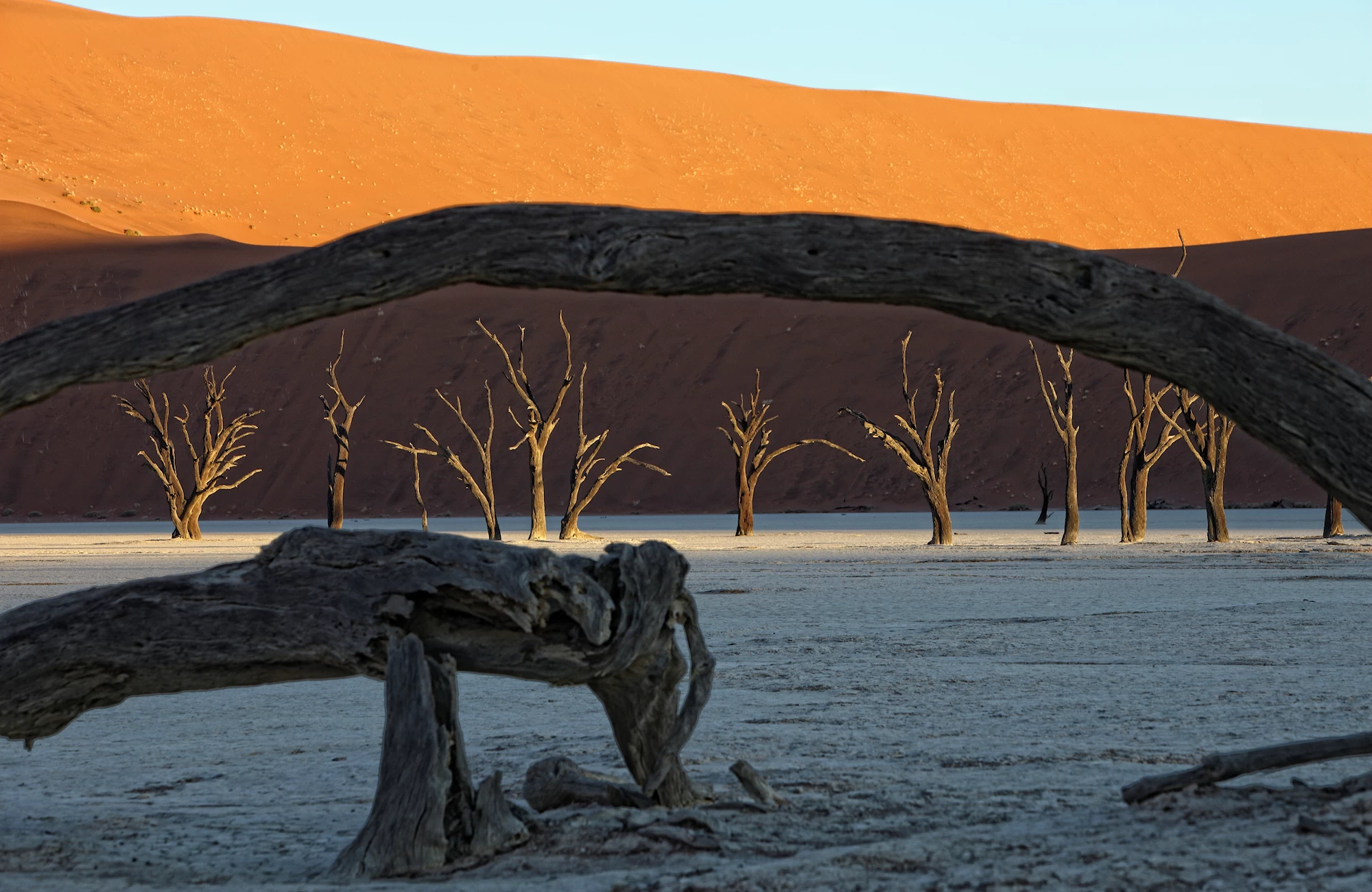
Namib-Naukluft Park, Dead Vlei, Namibia - Dead trees in front of an ancient desert dune.
The one characteristic which really makes the Bushmen different from all other races is that they have no sense of ownership at all. Where they live, there's nothing you can own.
by Jacobus Johannes Uys, 'The Gods Must Be Crazy', Film, 1980, Ster-Kinekor, Directed by Jamie Uyss
Jacobus Johannes Uys (1921 – 1996), better known as "Jamie" Uys, was a South African film director, remembered for writing and directing the comic allegory film, 'The Gods Must Be Crazy.' It was produced in 1980, and released in South Africa by Ster-Kinekor in 1982 as a limited domestic release. However, it was the 1984 United States release by 20th Century Fox, which made the movie, not only a box office hit, but the biggest foreign box office hit ever released in the U.S. This month's quote from this film is remarkable because its two sentences speak volumes about the nature of civilization, not to mention the profound arrogance, ignorance, and greed of the world, past and present. The movie takes considerable pains to educate viewers on who the people of the Kalahari Desert known as the "Bushmen" peoples are, and what makes them unique in the world. But that was more than four decades ago, and a lot has changed since then, and not for the better. The gods are indeed, crazy!
The "Bushmen" hunter-gatherer culture's ancestral territories span Botswana, Namibia, Angola, Zambia, Zimbabwe, Lesotho, and South Africa. As for "Bushmen," it comes from the Gwikwe Bushmen tribe itself. "Gwi" means "bush," and "kwe" means "people." If this culture has to have a name, their own terminology, in their own language, should be the correct one. It's not. The present-day term, the "San people," that's a colonial reference. Like the Bronze Age "Celts" of Europe, Bushmen had no name for themselves prior to the arrival of conquering African and European empires. "San" was a name given to Bushmen in 1990s, just like the ancient Greeks gave the Bronze Age peoples of Europe the name, "Celt." It's what civilizations do. They must label people because that's the nature of chauvinism. The politically correct name for Bushmen these days is the "San" people. It is derogatory name, meaning "gatherers," given to the Bushmen by pastoral African tribes who migrated onto Bushmen lands. "San" is a reference to poverty. And yes. These African tribes were civilized, that is, imperial-minded too - Africa style. To them, Bushmen were too poor to own cattle, and therefore, inferior. Despite the name "San" being an African racist term for other Africans, it stuck. Suffice it to say, at the time of first contact, whether by Africans or Europeans, the Bushmen were the very last, and oldest surviving hunter-gatherer cultures of the region. However, when 'The Gods Must Be Crazy' was filmed, the last true Bushmen as depicted in the movie, were practically already extinct, except for a few isolated Gwikwe.
The Bushmen were unique (past tense is intentional) for many reasons, but mostly because, besides the countries already mentioned, Bushmen also thrived in an inhospitable place - the Kalahari Desert. Bushmen adapted to climate change which formed the Kalahari about 20,000 years ago, possessing a unique knowledge of survival and a deep understanding of their environment. The name "Kalahari," means "great thirst," and spans most of Namibia, Botswana, and most of the northern Cape Province of South Africa. It is a semi-arid sandy savanna, formed around the end of the last Ice Age. It is also a well-known place to avoid for the peoples of Southern Africa. Those foolish or unfortunate who find themselves in the Kalahari have no hope of survival without modern technology. And yes. It is absolutely a fact that the true Bushmen Jamie Uys refers to in his 1980 film, had "no sense of ownership at all," and that there was "nothing [one could] own" in the Kalahari.
The story of 'The Gods Must Be Crazy' is unique as well. It is also a cautionary one. Bushmen lived happily in their natural environments, in perfect harmony and natural balance, since primordial times, which, collectively, for us anatomically modern humans is, about 130,000 years ago. However, since about the 15th-century, civilization's arrogance, ignorance, and greed, began creeping into the Bushmen world. That's the gist of Jamie Uys' story, albeit in comical fashion. The encroachment of civilization's "crazy" ways was not Jamie Uys' fault. In the late 1970s and early 1980s it was a sad fact, and a problem only government resources and policies could do something about. It's not that governments did nothing. They did. They made the problem and its tragic consequences for Bushmen permanent and irrevocable.
In 'The Gods Must Be Crazy, N!xau (pronounced En (click) ow), the Botswana Bushman star of the movie appears as "Xi" (pronounced as "Kee"). He and his tribe live happily in the remote Kalahari Desert in contemporary times, far from civilization. One day, a pilot throws an empty glass Coca-Cola bottle out of his airplane, which falls to onto the sandy ground, unbroken. Xi discovers this bottle one day, hunting. Fascinated with this strange object, he brings it home with him. Initially, Xi and his people assume the bottle to be a gift from their gods, just as they believe plants and animals are. Being innovative, they find many uses for it. But, unlike other gifts, there is only one glass bottle, which causes unforeseen conflict within the tribe. So, to return the tribe to harmony, Xi decides to make a pilgrimage to the edge of the world and dispose of bottle. It is on his pilgrimage, that Xi encounters the complexity of of both African and European civilization for the very first time. As for the rest of the story - watch the movie. The take away, if you have not already grasped it, is the metaphor for civilization, the unnatural empty bottle, which causes something new for Xi's people - conflict among the tribe. The movie ends with Xi, after his many trials and tribulations, and arriving at a cliff, which he believes to be the edge of the world, where he throws the bottle into the misty abyss. He is convinced his tribe's troubles are over. As for the movie, its story was supposed to end here, too.
The moral of the story is, civilization left the Kalahari Bushmen culture alone for millennia because there was nothing in the desert for civilizations to pillage. It remained so in Botswana until 1970s. The eviction of Bushmen from the Kalahari began when new drilling technology was made available to the Botswana government, first by the British government, then by the European Union. The purpose was to support African ranchers to make their agricultural economy viable year round, in the Kalahari. The objective was to improve lives by drilling into the Kalahari's vast, but deep underground aquifers. Prosperity came at the expense of someone else - imperial style. Access to water in an arid place allowed an influx of ranchers to move onto traditional Bushmen lands, displacing Bushmen tribes. Two decades later, De Beers diamond prospectors discovered diamond deposits within the protective Central Kalahari Game Reserve, and naturally, greed took precedence. The result was an eviction of all Bushmen peoples from their traditional lands by the Botswana government.
But the imperial onslaught against Bushmen began much earlier. The Portuguese arrived in Namibia in 1486, Europeans, encountering Bushmen for the first time. When the Dutch first arrived in the Cape of South Africa in 1652, colonists literally hunted Bushmen for sport to clear them from the land for commercial use. Ultimately, all Cape tribes were exterminated over the next two centuries. In 1884, the German Empire conquered what is today, Namibia, and which the Germans called Deutsch-SĂĽdwestafrika (German South West Africa). After gold, copper, platinum, and other minerals, diamonds were discovered in 1908. To encourage settlement and investment, the empire waged an active policy of genocide against indigenous Herero, Namaqua, and Bushmen tribes. And there are other horror stories. However, readers can research those for themselves.
The Unie van Suid-Afrika (Union of South Africa; 1910–1961), a signatory of the Treaty of Versailles after the First World War, and one of the founding members of the League of Nations, became responsible for the former German South West Africa. The Union was a self-governing dominion of the British Empire. The genocides, ended. And, of course, Appartheid was institutionalized by the Afrikaaner descendants of those Dutch settlers in the Union after the Second World War in 1948. Jamie Uys, twenty-six-years-old at the time, and like most anywhere in the world on any policy, had no say in the Union's policy matter either. Nor could he do anything about the fact that he was an Afrikaaner. He was a mathematics teacher and a farmer in the northwestern part of the country in the Lephalala River region at the time. But being an Afrikaaner, he was privileged, and did benefit from the new regime. He was appointed amagistrate and Justice of the Peace where he lived. It did not mean he was unemphatic, or had no love of the land, the wildlife, and all peoples. In 1951, he made his debut as a film director and writer with an Afrikaans movie called 'Daar doer in die bosveld' (Far Away in the Bushveld). It's about life in a remote hinterland - his specialty. The Union became the former Zuid Afkikaansche Republiek, and the present-day Republic of South Africa in 1961.
The thing is, what little remains of Bushmen are today's San people. They are a pacified, uprooted fringe society, sporting Nike shorts, shirts, etc., and completely marginalized in Southern Africa's African societies. They live on life support handouts, being civilized. Besides old men and women who still remember the old ways, there are no more real Bushmen left alive, living off the land, untouched by civilization as depicted in Jamie Uys' movie, 'The Gods Must Be Crazy.' There were in 1980, but not today. And for what it's worth, it is true that the star of the movie, N!xau, a true hunter-gatherer Bushman in 1980 (not a "civilized San" like others), had no concept of material wealth, or money at the time of filming. It is also true that Jamie Uys tried to pay N!xau as was the law, but N!xau just let the money - about R300 - blow away in the wind. Jamie Uys was interfering in Bushmen culture enough as it was, and publicly, at least in America, Uys maintained that "[the film] is just a slapstick comedy, with no message." However, in reality, Uys understood the geopolitics already in play, that politics would have an adverse impact on the reception of the movie if he was not careful with his comments during interviews. N!xau himself, agreed to participate in the movie to get the word of his people's struggle with encroaching civilization, out into the world. His message was "leave us alone," and Jamie Uys' message was "stop the insanity of civilized greed in the Kalahari." Officially, Jamie Uys left it up to intelligent audiences to figure the messages out. But that never happened. Rather, the opposite did. And, of course, the entire history of this movie became mired in propaganda myth and politics, and remains so to this very day.
In today's societies, most young people no longer give a damn about old people, or anyone except themselves. Moreover, most people are historically ignorant. And that's a fact. Nor do they know that in fact, the truly indigenous Bushmen culture is extinct because of Western imperial greed. And that brings us to imperial arrogance and ignorance.
Most educated people know of South Africa's anti-Apartheid struggle. It was a just cause. But Jamie Uys did not release the sequel, 'The Gods Must Be Crazy II' in 1989. The Chinese did, hoping to capitalize on Jamie Uys's earlier success. But Uys was the unaccredited dubbed voice of the character "Bob" in the movie. And this rip off version is a really bad version of the original. Almost certainly, Jamie Uys regretted his participation, but it paid his bills. It stars N!xau again. This time, he was paid $500,000 for his role and a Chinese name in a succession of Chinese productions which, unlike Jamie Uys's movie, turned out to be a mockery of Bushmen, but apparently a smash hit with Asian audiences. There were also three other sequels, each worse than the previous: 'Crazy Safari (The Gods Must Be Crazy III, 1991),' Crazy Hong Kong (The Gods Must Be Crazy IV, 1993)' and 'The Gods Must Be Funny in China (The Gods Must Be Crazy V, 1994). Enter ignorance. Rather than the Hong Kong Chinese producers, Jamie Uys was singled out, and targeted by anti-Apartheid politics, worldwide. He was branded a White Afrikaaner racist, accused of glorifying apartheid racism in South Africa, which, in fact was done by the Chinese in their four rip off sequels. Demonization ended Jamie Uys's reputation and career. A heart attack killed him in Johannesburg, South Africa, in 1996. One Afrikaaner down, many more to go. Why not the Hong Kong Chinese? Globalization. The British lease on Hong Kong was about to expire in 1997, when Hong Kong would revert back to the People's Republic of China. And China was of great interest to Western Capitalists to increase their profit margins. China was being geared up as future mass producers of cheap goods for Western Consumerism, to replace expensive domestic production in the West.
As for the West's "crusaders" riding the late 1980s, early 1990s, anti-Apartheid bandwagon, they were ignorant, but self-righteous masses, clueless about Jamie Uys' and N!xau's message concerning the then, threats faced by the Bushmen of the Kalahari. Yes, thanks to Jamie Uys, N!xau and his tribe, the world discovered the Bushmen of Kalahari - for the wrong reasons. But, practically no anti-Apartheid crusader bothered to educate themselves about who the Bushmen were, to understand their plight, or gave a damn. The star in this drama, N!xau, ended up living up to Namibia's and Botswana's much-desired "San" people label. As their propaganda poster child, he even purchased a modest farm with a farmhouse and cattle. The civilized lifestyle killed him. First, he was converted to Christianity in 2000, and was dead by Tuberculosis in 2003, in Tsumkwe, Namibia. It's really a reservation with a population of about 500. The village where he died is in remote northwestern Namibia close to the Botswana border, and called the San "capital" of Namibia. And nobody in the West gives a damn about the post-Apartheid South Africa today either, despite its dire socio-economic catastrophe affecting millions in the last two decades. Mission accomplished. South Africa is no longer in vogue, and what is out of sight is out of mind. Meanwhile the exploitation of the Kalahari out of sheer greed by governments and foreign corporations, without any regard for local populations or the environment, continues. And of course, no civilized anybody gives a damn. Today, every San person needs money to survive, so, there's "feel good" not-for-profit agencies for that.
The advent of social media, platforms for information exchange with seemingly no bounds, including that of stupidity, and the spread of utter lies for the sake clicks and likes, did most of the damage to what was left of Bushmen. This present-day social medium oracle, a toxic cocktail of factual truths and idiotic absurdity, exploits the 'The Gods Must Be Crazy' tragedy, saturating the narrative about the 1980 movie exploiting Bushmen for profit, rather than the Chinese, Western corporations, or the Namibian and Botswana governments, who actually exploited N!xau and his people. It's impossible to discern lies from truths if one does not have knowledge of the subject matter. Let's face it. We are all ignorant of many things. We cannot know everything. But since irresponsible people naturally find it easier to be lazy, many turn to blind belief. It's why spreading profound lies to ignorant consumers is so much easier to convey rather than complex truths, hardly understood. Still, the truth is out there if one cares to seek it. If not, social media are brilliant tools to keep people in the dark. It's how modern darkness rolls.
Meanwhile, empires and their ignorant masses have misery to inflict someplace else. As before, many today continue to believe they are supporting the right thing this time against, or for, other societies they hardly understand. It is a repeat, very much like those failed empires of yesteryear - for the same reasons, arrogance, ignorance and greed. Arrogance, ignorance, and greed is doing fine, and at mostly everyone's expense. And, of course, nobody inflicting pain on others someplace else is to blame.
The gods are indeed, crazy!
(Discover 'The Gods Must Be Crazy' at 'IMDb'. Also read the New York Times article, dated April 28, 1985, 'THE GODS MUST BE CRAZY' - A TRULY INTERNATIONAL HIT).
Think! is operated by Chrysalis Books (chrysalisbooks.ca).
Terms of Use
You provide implicit agreement to comply by these Terms of Use by using/viewing the Think! (think.chrysalisbooks.ca) website [the Service]. All images, texts, and codes [Digital Assets] on the Service are copyrighted and owned by either Jozef Borovský, Chrysalis Books Author [the Owner]; or vendors; or contributors - collectively [Content Provider(s)]. All Digital Assets on the Service are the property of either the Owner or the Content Provider(s). Digital Assets on the Service are created by the Owner, the Service, or reproduced under license, and with permission provided to the Owner or the Service by the Content Provider(s). No Digital Assets may be downloaded or reproduced for any purpose, in any manner, unless expressly stated by the Service, or granted written permission by the Owner or Content Provider(s).
Privacy Policy
Everyone's privacy is important at Think! Given the state of the world in some places, nowadays, expressing one's thoughts to an anonymous public is an unwise practice. But, it has mostly been this way with Thinking deemed by conformists, heretical or conspiracy theory. Thinking is not for everyone either, which is a pity - humanity is poorer for it. Nobody at Think! can fix that. Still, everyone is entitled to an opinion, but arguing with ignorant people at Think! is not. Therefore, by this policy, access to certain Think! content is limited to subscribed members only, unless, that is, Content Provider(s) decide to make their work(s) public. By this policy, Think! has no control over public versus private content. It is not a desire at Think! to change anyone's belief in anything, however, learning something new from different perspectives, is.
Think! is operated by Chrysalis Books (chrysalisbooks.ca).
Terms of Use
You provide implicit agreement to comply by these Terms of Use by using/viewing the Think! (think.chrysalisbooks.ca) website [the Service]. All images, texts, and codes [Digital Assets] on the Service are copyrighted and owned by either Jozef Borovský, Chrysalis Books Author [the Owner]; or vendors; or contributors - collectively [Content Provider(s)]. All Digital Assets on the Service are the property of either the Owner or the Content Provider(s). Digital Assets on the Service are created by the Owner, the Service, or reproduced under license, and with permission provided to the Owner or the Service by the Content Provider(s). No Digital Assets may be downloaded or reproduced for any purpose, in any manner, unless expressly stated by the Service, or granted written permission by the Owner or Content Provider(s).
Privacy Policy
Everyone's privacy is important at Think! Given the state of the world in some places, nowadays, expressing one's thoughts to an anonymous public is an unwise practice. But, it has mostly been this way with Thinking deemed by conformists, heretical or conspiracy theory. Thinking is not for everyone either, which is a pity - humanity is poorer for it. Nobody at Think! can fix that. Still, everyone is entitled to an opinion, but arguing with ignorant people at Think! is not. Therefore, by this policy, access to certain Think! content is limited to subscribed members only, unless, that is, Content Provider(s) decide to make their work(s) public. By this policy, Think! has no control over public versus private content. It is not a desire at Think! to change anyone's belief in anything, however, learning something new from different perspectives, is.
2024, Jozef Borovský. Think! Chrysalis Books